



.avif)
For years, Belgian employers relied on a familiar “golden trio” to build competitive remuneration packages: gross salary, a company car, and net expense reimbursements, occasionally supplemented with meal vouchers or insurance plans.
The model was simple, widely understood by candidates, and effective.
Today, that formula is under increasing pressure.
- Gross salary, has become significantly more expensive for employers, while delivering diminishing net returns for employees.
- Company cars, once a cornerstone of Belgian remuneration, are losing appeal. Higher benefits in kind reduce employee attractiveness, while reduced deductibility and rising purchase prices put pressure on employer budgets.
- Net expenses, long used to boost purchasing power efficiently, are now subject to stricter rules, heavier documentation requirements, and increased scrutiny — turning what was once routine into a growing compliance risk.
The conclusion is unavoidable:
Belgian employers need new ways to reward and retain talent without structurally inflating gross salary or increasing fiscal and legal exposure.
A three-part series on smarter remuneration
This article is the first instalment in a three-part series exploring smarter ways to reward employees beyond traditional gross salary increases. Each part examines practical alternatives and ranks them based on real-world usability.
Part I: Financial optimisation (you are here)
Focuses on net-efficient mechanisms that maximise employee value without inflating fixed salary costs.
Part II: Flexibility & personalisation
Explores how cafeteria plans, mobility budgets, and other flexible options allow employees to actively shape their own compensation package.
Part III: Quality-of-life benefits
Looks at non-cash elements, such as wellness perks and lifestyle benefits, that increasingly drive retention and strengthen employer branding.
Comparing Benefits: How We Measure Their Impact
Before we dive into the specifics, it’s important to note that not all benefits are created equal. Each solution offers a different mix of employee value, cost implications, and implementation complexity. To make it easier to compare them, we use a practical scoring system, giving a clear view of which options deliver the most impact while remaining realistic for employers to implement.
Each solution is assessed using three practical criteria:
- Employee impact
- Employer cost
- Ease of implementation
CAO 90 bonus – Collective performance optimisation
What it is
The CAO 90 bonus is a collective performance-based bonus governed by Collective Labour Agreement No. 90.
It applies to a clearly defined group of employees (e.g. the entire company, a business unit, or a department) and is based on predefined, measurable objectives that must remain uncertain at the time of introduction.
Typicaleligible objectives include:
- Company revenue or profitability targets
- Absenteeism or safety indicators
- Customer satisfaction or quality metrics
Objectives linked to individual performance or guaranteed outcomes are explicitly excluded.
Why companies use it
The appeal of CAO 90 lies in its favourable net treatment compared to a classic gross bonus.
For the employee
- No personal income tax
- Only a 13.07% solidarity contribution
For the employer
- A special employer contribution of 33% (instead of standard social security)
What it delivers in practice

For a marginally higher employer cost, the employee receives more than €1,000 additional net income.
Constraints to consider
- A formal bonus plan must be drafted and approved in advance
- Objectives must be measurable, transparant, and fixed the entire reference period
- The collective nature excludes individual performance differentiation
- Legal maximum amounts apply (including indexed caps for 2026)
Score

Bottom line
CAO 90 is a powerful net-efficient tool to reward collective performance without increasing fixed salary costs.
Its main limitation is not financial, but structural: once objectives are set, flexibility disappears. Successful implementation therefore requires careful design and disciplined legal and payroll execution.
Warrants – Guaranteed net optimisation for variable pay
What they are
In Belgium, warrants are listed financial instruments granted by the employer through a specialised provider.
Employees accept the grant and typically sell the warrants immediately to limit market risk.
The optimisation lies in how the benefit is valued and taxed at grant, rather than at payout.
Why companies use them
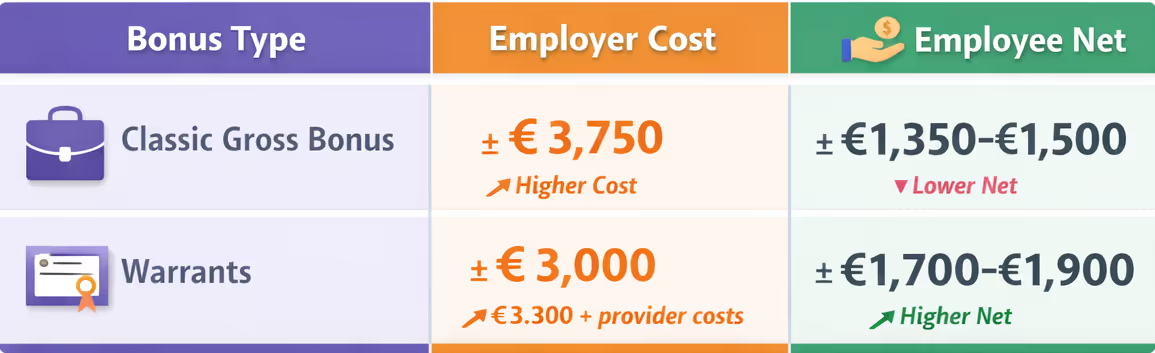
Warrants deliver more net than a classic cash bonus and, unlike CAO 90, can be guaranteed.
This makes them suitable for:
- Fixed annual bonuses
- 13th month conversions
- Recurring variable remuneration
What it delivers in practice (€3,000 like-for-like)
Constraints to consider
- Correct structuring and documentation are essential
- Requires a specialised provider
- Best suited for variable pay (not base salary)
- Clear communication is crucial, as not all employees immediately understand the mechanism
Score

Bottom line
Warrants strike a strong balance between net efficiency and employer cost control.
Their ability to be guaranteed makes them particularly attractive for recurring bonuses, provided execution is rigorous.
Profit sharing – Linking reward directly to company success
What it is
Profit sharing allows companies to distribute a profit premium from a completed financial year under a specific legal framework.
Unlike CAO 90:
- It is not target-based
- It requires actual profit
- It involves formal corporate decision-making
Companies may opt for:
- An identical premium for all employees, or
- A categorised premium based on objective criteria
Why companies use it
Profit sharing combines very favourable net treatment for employees with low employer charges.
Employee
- 13.07% solidarity contribution
- 7% tax
- No progressive income tax
Employer
- No employer social security contributions
- Funded from post-corporate-tax profit (not deductible)
What it delivers in practice (€3,000 profit premium)
- Net received: ± €2,425
Constraints to consider
- The company must have profit in the relevant financial year
- A formal decision by the general meeting is required
- Total profit premiums are capped and may not exceed 30% of the company’s overall wage mass
- Cannot replace or convert existing salary, bonuses or benefits
- Allocation rules must be applied consistently and within the legal framework
Score

Bottom line
Profit sharing offers one of the strongest net outcomes for employees, provided the company is consistently profitable.
Its structural constraints make it less flexible, but highly attractive where applicable.
Key takeaway
CAO 90, warrants and profit sharing all pursue the same goal: maximising employee net income without structurally increasing gross salary costs.
Each tool comes with its own mechanics and constraints, but together they illustrate a clear shift in the Belgian market toward smarter, more targeted forms of variable remuneration.
In Part II, we move from optimisation to choice, and explore how cafeteria plans and mobility budgets allow employees to actively shape their own salary package.


Follow us
Autres articles



Other articles